Sense Making or Making Sense
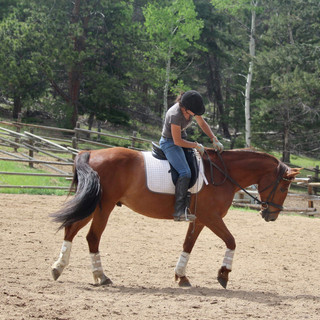

There is something different about working with horses that present behavioral challenges, this is something I did not fully recognize until later in my training career. Behavioral issues are not limited to dramatic reactions such as bucking, bolting, or rearing. They can also present in much more subtle forms of resistance. A horse may be perceived as lazy, unwilling to bend, unable to maintain a straight line, or simply resentful of arena work. Unfortunately, these horses are often labeled according to their behavior rather than evaluated for what may be contributing to it.
When we begin to understand the relationship between biomechanics and behavior, we learn to look at these horses differently. What we perceive as unwillingness may actually be the horse's inability to perform a movement comfortably or correctly. Learning to recognize these subtle forms of communication gives us an opportunity to address potential underlying issues before they develop into more significant physical or behavioral problems. Not all horses express discomfort through dramatic behavior. Some simply struggle to meet our expectations. It is our responsibility to recognize the difference between unwillingness and physical inability. Each horse will present a unique set of circumstances. As trainers and riders, we must learn to navigate the process of problem solving by combining scientific knowledge with careful observation of the individual horse. Our approach should be horse specific rather than problem specific. For example, if we are presented with a horse that is labeled as “spooky,” we may immediately attempt to address that behavior through desensitization techniques. Repeatedly exposing the horse to unfamiliar objects, tossing objects around the horse, or attaching objects to its body until it learns to “accept” the perceived threat may reduce the outward behavioral response. However, has the horse genuinely become more comfortable and confident, or has it simply accepted to not communicate, also known as” learned helplessness". Although appropriately applied desensitization can be a valuable training tool, we must first consider why the horse is exhibiting the behavior. Is the horse experiencing physical discomfort? Does it struggle with balance or coordination? Is there a lack of understanding, confidence, or trust? By focusing solely on eliminating the unwanted behavior, we risk overlooking valuable information the horse is attempting to communicate. Understanding the individual horse, both mentally and physically, allows us to develop training strategies that address the potential underlying causes rather than simply managing the symptoms. The absence of a behavioral response does not necessarily indicate the absence of fear, discomfort, or anxiety. Starting with a hypothesis is a good basis for a successful outcome. A hypothesis can be developed once the horse has been cleared of any medical issues by a veterinarian. Horses need help with their particular set of circumstances in the particular moment. This means when you are evaluating a horse and they are frightened and spooking or anxious, you have to begin with why. What does the horse's physique look like? How is the posture? When did the behavior start? How can you apply theoretical evidence to this situation in a way that begins to peel the layers of identifying the root problem.


Comments